The next presentation by the Owen Sound Field Naturalists (OSFN) will feature Todd Morris, PhD, a prominent federal Research Scientist with Fisheries and Oceans Canada.
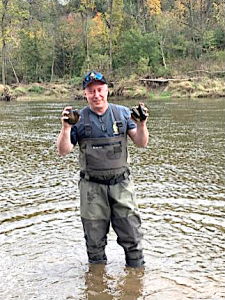 Morris’s talk here ten years ago was so enthusiastically received that I invited him to return this year, with ‘A Brief Introduction to Mussels of the World’ plus his main topic – ‘Is conservation translocation a path forward to recover Canada’s endangered freshwater mussels? The story of Kidneyshell (Ptychobranchus fasciolaris) in the Thames River, Ontario.’
Freshwater mussels are among the most endangered animals in the world. Their extended lifespan, sedentary nature and unique life history, requiring a period of parasitism on a vertebrate host, make them particularly vulnerable to habitat alteration through urban and agricultural development, plus over harvesting for pearls and buttons, and the effects of invasive species.
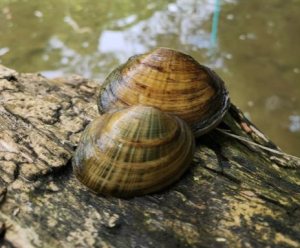
Nearly 40% of all Canadian species have been assessed as at-risk by the Committee on the Status of Endangered Wildlife in Canada (COSEWIC) and most of those have experienced some local extirpations. Conservation translocation to re-establish extirpated populations is one approach being used in Ontario to help stabilize and recover aquatic species at risk.
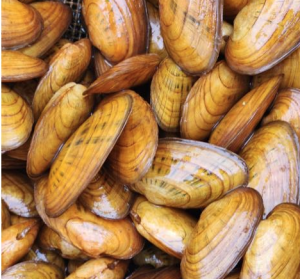
Kidneyshell were last recorded alive in the Thames River over two decades ago but efforts are now underway to re-establish this population through hatchery propagation with nearby Sydenham river stock. If successful, this approach will help to ensure the long term survival of the species in Canada.
This event will take place at 7:00 p.m. just after the 6:15pm OSFN Annual General Meeting, on Thursday, June 11, at the Harry Lumley Bayshore Community Centre.
Everyone is Welcome! Admission is by Donation, Free for OSFN Members and doors will open by 6:00 p.m.
In addition below is a Zoom link in order to register, in advance, for the Mussels presentation only:
https://us06web.zoom.us/meeting/register/B5GVJ5EnS0KDZtqevttJzA
———————————————-
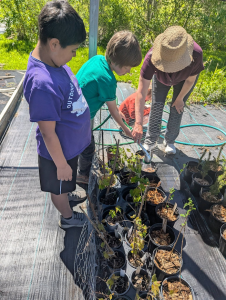
Giving the ‘toddler trees’ a good watering
Coordinator Amanda Eriksen reports on the May 31st Young Naturalists’ Introduction to Native Seed Planting with Nancy Brown at the Inglis Falls Arboretum Alliance (IFAA) & Nursery “Nancy was an excellent host for the Young Naturalists. We learned all about the native plants in Grey County and she had lots of different seeds for the kids to see. After a tour of the plant nursery, we helped gather up some leaves. We then helped to plant some seeds and ‘toddler trees’ and tucked them into their “crib” or the “playpen” with a good watering. Nancy provided a snack and a craft as well. We collected closed dandelions, set our “wish” or goal, then glued them in a jar. The hope is that they will open in the jar and the kids can look at it and be reminded of their goal. We had some budding entomologists who spent some time insect hunting and the kids ended by playing tigers in the grass. For next month, I am thinking of doing a mini bio blitz at the Oliphant Fen as we haven’t gone up the peninsula yet this year and it’s such a biodiverse place.”
———————————————
Thank you to Norah Toth, for this snapshot of the 2026 Huron Fringe Birding Festival, whose headquarters are at MacGregor Point Provincial Park, and which ran from May 22 to May 31. Over 90 events were enjoyed by the 462 Festival registrants, during which 196 bird species were recorded.
Highlights included the morning to night Big Day led by Kiah Jasper and Alessandra Kite. In
15.5 hours, this group of 20 participants broke the record from last year with a total of 155
species.
A highly sought after Connecticut Warbler caused quite a stir. This large warbler is a skulker, spending much of its time foraging on the ground. It breeds in boggy spruce or tamarack forests and winters in South America. Sighting the Connecticut Warbler during migration does not happen every year in Bruce County, so it was a lifer (first time ever seen) for many of the 50 people who got their eyes on it.
The most surprising, and exciting, observation was not seen, but heard, after dark. Two local birders, Pam Kinchen and Norah Toth, were sitting around a campfire and heard a bird that sounded somewhat like a Whip-poor-will. After discussion Pam said: “It’s a Chuck-will’s-widow.”
Realizing verification would be important, Norah taped it. This tape was sent to the local e-bird reviewer, Kiah Jasper, who replied very excitedly that indeed it was a Chuck-will’s-widow and a first record for Bruce County. This bird, which is considered threatened in the United States, overshot its destination during migration, as it nests no further north than southern Ohio. Unfortunately, its visit to MacGregor Point was a one-night wonder.
New in 2026 was a 100 Species pin which was received by a good number of participants.
The Norah Toth Award was also granted posthumously to Dave Schaus, at the Birder’s Banquet, for his many contributions to birding and nature in Bruce County.
————————————————-
I have been able to get out for a few Nature Rambles myself, either on foot or cycling, and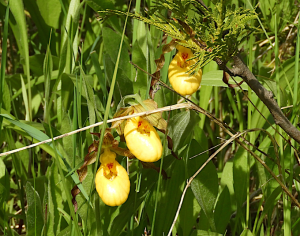 have enjoyed seeing many different butterflies and moths, birds, and blooms too, especially the wonderful parade of yellow wildflowers from Springtime to Autumn: Coltsfoot, Dandelion, Marsh Marigold, Violets, Buttercups, Yellow Lady’s Slipper Orchids, Wild Mustard, and more to come. An extra treat for me at this time of year is to experience the beautiful and fragrant blossoms of the Horse Chestnut trees.
To close, a Nature quote from Moira Welsh’s Happily Ever Older – Revolutionary Approaches to Long-term Care, published in 2021. Developing videos and virtual reality (VR) experiences with Nature themes, helps to create an environment that is safer, more welcoming … and have brought some relief, feelings of safety, comfort and even joy to some residents, providing the sounds of ‘water, wind and all the different types of birds… a dog barking… a visual of the ocean breaking on a rock accompanied by spatial audio that changes with the viewing experience.’ These approaches provide engaging experiences as well as a better comfort level for residents, minimizing the frequent medications and restraints that have been the norm for so long.